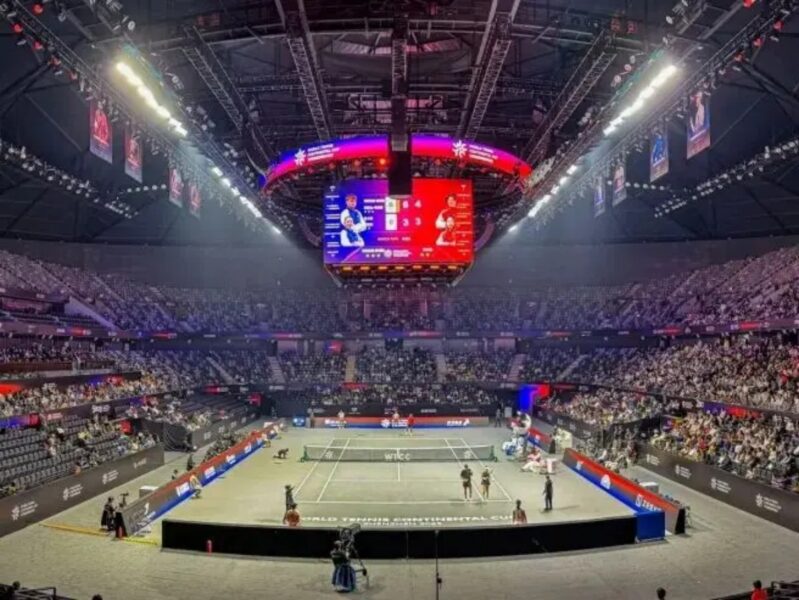
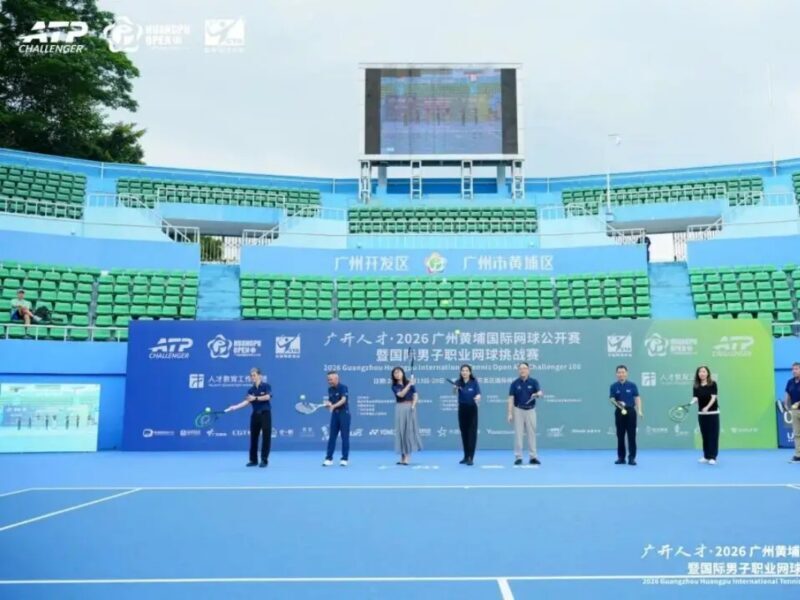
Padel Tennis Sport, Fast-Growing Racket Sport Worldwide
Industry News 2026-09-09
Introduction: Why padel sport & padel tennis Are Exploding Globally
With over 10‑years of foreign‑trade experience at Guangdong Uphos Sport Co., Ltd., I have witnessed how padel sport reshapes the global racket‑sports industry. Our company originally manufactured tennis‑court accessories, and gradually expanded into sports court fencing, sports lighting systems and acrylic court surfacing materials. Most of our exported court facilities serve international tournaments and premium clubs, earning consistent positive feedback from overseas clients. Long‑term partners often send trending products for custom manufacturing, through which we first learned about padel tennis. As early as five years ago, clients began inquiring about padel sport. At the very beginning, we lacked relevant experience; overseas buyers only sent reference images and asked if we could produce matching parts. Unfamiliar with material specifications, we issued quotations yet closed zero deals. Driven by rising global inquiries, we launched internal R&D and product design for this category. Market research shows the global padel sport market is undergoing explosive expansion, reaching an estimated market value of EUR 6 billion in 2026 with more than 35 million active participants. This boom fuels massive infrastructure expansion for new courts across continents, where Europe accounts for nearly 58.6 % of global market share. Spain, Italy and the UK act as core growth drivers. A notable industry shift involves retrofitting under‑used traditional tennis and soccer fields into high‑yield mixed‑use padel tennis centers. The United States sits at an early‑stage growth phase: court numbers jumped from fewer than 20 in 2019 to over 650 by mid‑2025, and are projected to hit 6,800 by 2030. In the UAE (Dubai) and Saudi Arabia, padel sport is overtaking golf as the preferred option for premium corporate social and wellness programs. The Asia‑Pacific region ranks among the world’s fastest‑growing zones, posting a projected compound annual growth rate between 10.3 % and 16.5 %. Across Southeast Asia, padel tennis facilities are integrated as high‑value assets within luxury resorts, corporate campuses and upscale gated communities. This surging popularity creates huge demand for newly‑built or retrofitted courts overseas, calling for reliable suppliers capable of one‑stop service. With 28‑years expertise in sports‑venue construction, Uphos Sport delivers complete material packages for padel tennis projects.
Part 1: Overview — What Is padel sport and Professional padel tennis Events
Clarify industry definitions among padel sport, padel tennis and tennis paddle.
These three terms are frequently mixed‑up in the industry, yet they carry fundamentally different meanings. padel sport and paddle tennis are two distinct sports with separate court infrastructure and competition rules; meanwhile, a tennis paddle refers to a category of sports equipment.
Below are precise industry definitions and distinctions:
1. padel sport
Industry Definition: A global emerging racket sport governed by the International Padel Federation (FIP), heavily reliant on specialized venue infrastructure. It blends elements of tennis and squash.
Core Features:
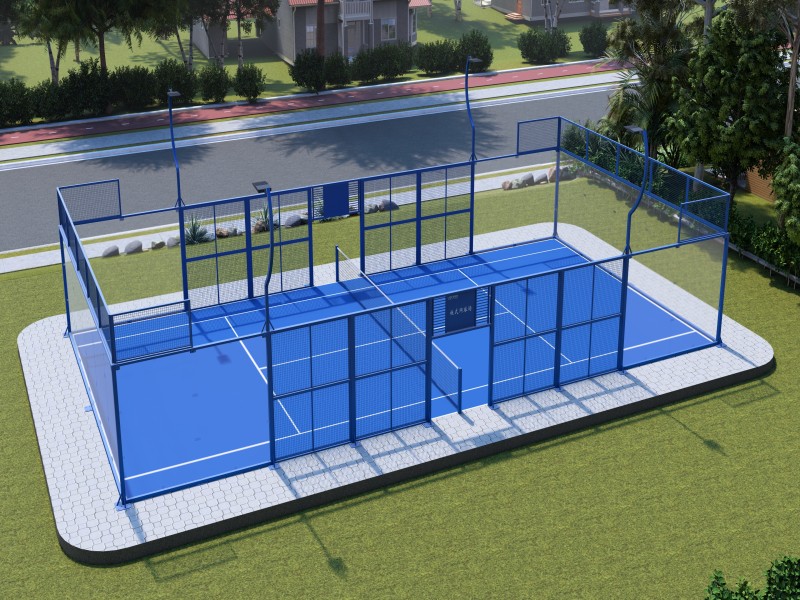
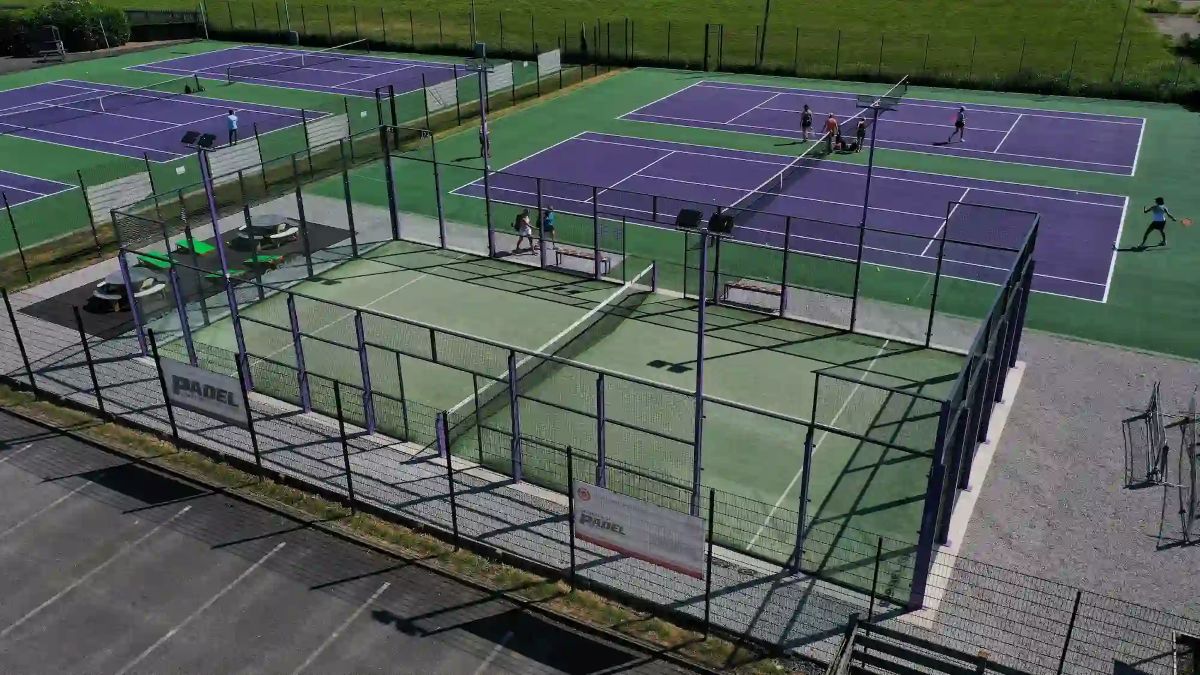
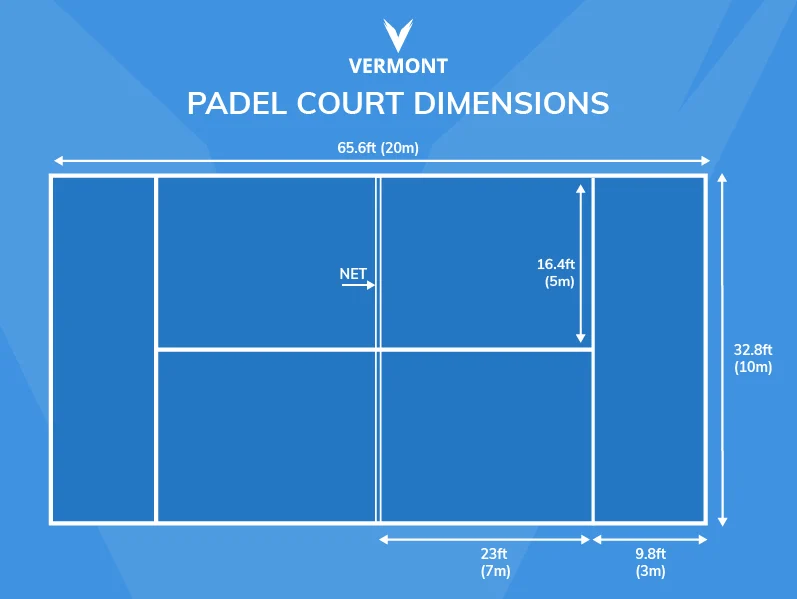
- Infrastructure dependency represents its biggest physical distinction versus other sports. A standard playing area measures 10 m × 20 m and must be fully enclosed with tempered glass and metal fencing; walls become part of match tactics since players can continue rallies after the ball bounces off glass panels. Artificial turf serves as the typical playing surface.
- Equipment: Players use solid, perforated string‑less rackets (strictly called Pala) plus low‑pressure special padel balls.
2. paddle tennis (rebranded as POP Tennis today)
Industry Definition: A century‑old tennis derivative sport mainly popular across North America. To eliminate confusion with fast‑growing padel sport, it officially rebranded to POP Tennis back in 2015.
Core Features:
- A downsized open‑air tennis variant. Courts remain completely open without glass or fencing, normally laid with traditional acrylic hard‑court surfacing.
- Rules & Gameplay: It follows standard tennis scoring yet restricts players to under‑arm serves, using smaller courts and rackets compared with regular tennis.
Industry note: Clients building venues for padel sport need heavy‑duty steel structures, glass and fencing. Those playing paddle tennis only require remarking lines on existing hard‑surface tennis courts.
3. tennis paddle (string‑less racket / general‑purpose gear term)
Industry Definition: This is equipment nomenclature instead of the name of a sport.
Core Features:
- Equipment attribute: Within sports manufacturing and foreign trade, a tennis paddle describes all string‑less hitting tools built from solid materials such as carbon fiber, fiberglass combined with EVA foam or polymer honeycomb cores.
- Scope of use: It acts as a broad hardware term. Rackets used for padel sport, paddle tennis, and even the booming Pickleball can all be categorized under the product umbrella of tennis paddle within English‑language trade catalogs.
Summary Table for Key Differences
| Dimension | padel sport | paddle tennis / POP Tennis | tennis paddle |
| Industry Category | Sport discipline | Sport discipline | Sports equipment / trade category |
| Court Requirement | Fully enclosed (glass + steel fencing); walls participate in gameplay | Open layout without walls; converted or downsized traditional tennis court | Not applicable (hand‑held gear) |
| Surface Material | Silica‑sand infilled artificial turf | Traditional hard‑court acrylic material | Not applicable |
| Target Markets | Dominant across Europe, Middle East, Latin America | Mostly limited to North America | Globally‑used English trade term |
Part 2: Investment‑Value Analysis for Overseas Modern‑Style padel tennis Venues
Why padel tennis attracts massive global capital for new builds boils down to its core commercial logic: it delivers exponentially higher venue revenue and strong user loyalty with a smaller land footprint. For overseas venue investors, this represents a high‑certainty business opportunity.
When introducing court hardware to club owners and real‑estate developers, focus on these three core commercial strengths:
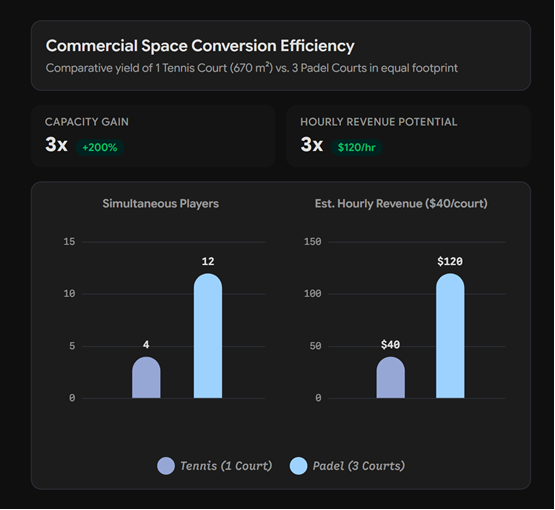
1. Exceptional space‑use efficiency: One tennis court equals three padel tennis courts
The internal dimension of a padel tennis court measures merely 10 m × 20 m (200 m²). Including surrounding buffer zones, its overall land occupation reaches roughly one‑third of a conventional tennis court (600‑700 m²).
- Higher visitor throughput & rental income: A full‑size tennis court holds maximum four double‑game players. Converting the same land plot into three padel tennis courts simultaneously accommodates twelve paying participants.
- Strong return on hardware investment: Although initial purchases include metal fencing, panoramic glass and anti‑glare LED lighting, rental revenue multiplied across more playable courts quickly offsets capital expenses.
2. Fast payback cycle plus low operating overheads
Many growing‑market regions such as the UK and USA are retrofitting idle tennis facilities into mixed‑use padel tennis centers. Fast ROI comes not only from heavy foot traffic but also modern venue materials:
- Modular infrastructure cuts local labor costs: Modern padel tennis steel frames, fencing and light poles are highly standardized. Shipped in containers for on‑site modular assembly, they drastically reduce expensive local welding and installation labor expenses.
- ‑ Prime night‑time operating hours: Fully‑enclosed padel tennis courts paired with high‑quality dedicated LED lighting concentrate illumination inside boundaries without light pollution. Venues achieve high booking rates during popular after‑work evening social hours.
- Low‑maintenance playing surfaces: Silica‑sand infilled artificial turf or heavy‑duty acrylic surfaces require almost zero day‑to‑day upkeep compared with clay courts or regularly‑repainted hard tennis courts.
3. Broad participant base with low technical barriers
Traditional tennis imposes steep learning curves; beginners need months of practice to sustain long rallies and frequently drop out. By contrast, padel tennis delivers far higher user‑conversion rates.
- Instant positive feedback: Carbon‑fiber tennis paddle rackets feature large sweet spots; surrounding glass panels stop balls flying out. Total newcomers can enjoy long engaging rallies after only twenty minutes on‑court.
- Strong social features: Matches are almost exclusively doubles (2 vs 2). Compact court dimensions encourage easy communication among four competitors. “Low frustration plus social interaction” drives high repeat booking rates.
Part 3: Standard Construction Requirements for a padel tennis court
| Construction Module | Official FIP Standard Specification |
| Internal Court Dimensions | Pure playing zone: 10 m × 20 m (0.5 % tolerance). Minimum indoor ceiling clearance 6 m; high‑end competition venues normally adopt 8 m clearance to avoid interfering with lobs. |
| Enclosure System | Full enclosure mandatory. Rear‑wall total height: 4 m (3 m tempered glass + 1 m metal mesh). Side‑wall height steps gradually down to 3 m. Glass thickness: 10 mm or 12 mm safety‑tempered glass. |
| Lighting System | Anti‑glare LED sports lights; standard 6‑meter light poles. Amateur‑club level: 400‑500 lux average illuminance. Tournament / broadcast‑grade: 750‑1000 lux flicker‑free output. |
| Surface Layer | Mainstream solution: 10‑15 mm high‑density monofilament or texturized artificial turf, evenly infilled with special silica sand to tune ball speed and player sliding. Very few outdoor venues use porous permeable acrylic. |
Beyond baseline FIP requirements, regional preferences differ for real‑world overseas procurement projects:
- Middle‑East markets (dominated by premium indoor builds): Hot climates drive demand for air‑conditioned indoor venues. Buyers strongly favor panoramic‑style padel tennis court layouts (rear wall without vertical support posts, continuous glass panels). Strict expectations apply for coating finish and high‑lumen lighting; these represent high‑budget visual‑focus projects.
- European & North‑American markets (outdoor wind‑load & corrosion resistance): A large share of venues sit outdoors. Coastal zones such as Florida enforce strict building‑code rules. Export‑bound steel structures need documented wind‑load performance plus heavy‑duty hot‑dip galvanizing for rust protection against rain and humidity.
- Southeast‑Asian markets (high‑humidity drainage): Venues are frequently built within resorts and premium real‑estate communities. Heavy seasonal rainfall requires enhanced under‑surface drainage plus improved salt‑spray‑resistant coatings for metal fencing.
Part 4: Core Materials for padel court: Fencing, Lighting and Artificial‑Turf Surfaces
1. Enclosure & Fencing System
Fencing functions not merely as a boundary but as a frequently‑stressed structural component for padel court. Overseas purchasers prioritize safety and long‑term durability.
- Height rules strictly follow FIP standards: rear walls reach total 4 m height (3 m safety tempered glass at bottom plus 1 m welded wire mesh above). Side‑panel heights taper from 4 m down toward 3 m depending on layout.
- Anti‑corrosion treatment proves critical for coastal humid territories across Southeast Asia, Middle East and coastal North‑west Europe. Premium builds implement dual protection: hot‑dip galvanizing plus outdoor‑grade polyester powder coating, delivering 5‑10‑year anti‑rust performance for steel tubes and welding joints under salt‑spray exposure.
- Wind‑resistance compliance matters greatly for open‑air European and American venues. Support posts adopt thick‑wall profiles (80×80 mm or 100×100 mm with ≥3 mm wall thickness). Providing finite‑element analysis reports for specified wind‑load ratings substantially improves conversion chances for engineering‑focused buyers.
2. Lighting System
Lob shots feature heavily within padel tennis gameplay. Players frequently look upward toward airborne balls, so lighting specifications exceed requirements for conventional tennis facilities.
- Anti‑glare performance ranks as the top priority. Specialized LED sports lights fitted with asymmetric optical lenses confine light output onto playing zones and prevent blinding glare when athletes look up to track high balls.
- Illuminance tiers align with project budgets:
1)Amateur / commercial‑club level: Four 6‑meter poles equipped with 4‑8 × 200 W LED modules deliver 400‑500 lux average illuminance with uniformity index >0.5.
2)Tournament / broadcast‑grade upgrade: 750‑1000 lux flicker‑free output required, compatible with high‑definition broadcast cameras. Outdoor‑use fixtures shall hold IP65 / IP66 ingress‑protection ratings against rain, alongside IK08‑or‑above impact resistance to withstand fast‑flying tennis paddle‑hit balls.
3. Artificial‑Grass Playing Surface
Controlled sliding defines user experience on padel court. Surface material directly influences athlete joint health and ball‑play feel.
- Wear resistance distinguishes padel turf from soccer grass. Short 10‑12 mm high‑density texturized or monofilament yarn locks silica‑sand infill securely, resisting early fiber flattening under frequent sharp turns and stops.
- Slip‑resistance & cushioning rely on evenly distributed dried silica‑sand infill; it supplies sufficient traction for quick acceleration while permitting controlled sliding movements that protect players’ knee meniscus from sudden locking‑up injuries.
- Climate‑adapted specifications for global regions:
1)Middle East & Australia (strong UV radiation): Grass yarns incorporate premium UV‑stabilizer masterbatch to resist brittleness and color fading under intense sunlight.
2)Southeast Asia & South America (rainy humid): Reinforced highly‑permeable backing enables drainage performance >60 liters per square‑meter per minute; courts become playable within 30 minutes after heavy rainfall.
Part5: Supporting‑Facility Design Considerations for padel sport and tennis paddle‑oriented Venues
1. Enclosure System: Flush alignment and predictable ball‑rebound behavior
Given comparatively lower impact force generated by a tennis paddle, ball‑rebound trajectories off glass and mesh must remain fully predictable.
- Flush‑finish requirement: 10 mm /12 mm tempered glass panels and upper welded‑wire mesh shall sit on one single vertical plane. Protruding screws, misaligned frames or structural offsets create erratic bounces at seam lines — a quality flaw unacceptable for professional‑grade club venues.
- Mesh aperture and rebound feedback: Side‑wall & top‑section welded mesh commonly uses 50×50 mm or 50×40 mm opening dimensions. These calibrated dimensions prevent balls getting trapped within openings while delivering slower rebound responses distinct from glass surfaces for tactical cut‑shot gameplay.
- Anti‑collision rounded‑edge treatment: Players sprint toward barriers during recovery shots. Quality‑focused designs implement rolled rounded edges for all exposed metal posts, plus countersunk mounting screws for glass panels to reduce abrasion‑injury risks.
2. Spatial Layout: Intense in court rallies plus out of court recovery play (Salida)
Shorter‑length tennis paddle instruments make padel sport a net‑oriented close‑quarters contest with frequent net intercepts, imposing unique spatial‑planning constraints.
- Recovery‑play access doors: Rules allow athletes to exit the court through side doors and return outbound balls back across the net. Side access openings range 0.82 m‑1.05 m wide. Critical design note: No horizontal ground beam may sit along door bottom edges; surfaces must sit completely flush to eliminate tripping hazards for sprinting players.
- Outer‑zone clearance space: To support FIP‑level out‑of‑court recovery play (Salida), a minimum 2‑meter‑wide × 8‑meter‑long obstacle‑free buffer area must be reserved externally beside side exit doors. This specification needs confirmation at drawing‑review phase for tournament‑qualified projects.
3. Lighting angle strategy for lob shot gameplay
During matches using a tennis paddle, lob shots and overhead smash counter‑attacks represent core tactical moves. Players spend approximately 40‑50 % of total match time looking upward toward airborne balls.
- Pole‑placement avoids direct line‑of‑sight glare: Four 6‑meter light poles cannot be positioned arbitrarily like soccer‑field lighting setups. They install along outer sides of the 20‑meter long perimeter, typically offset 4 m or 5 m away from the net line. This layout keeps direct lamp sources outside players’ upward viewing sightlines during baseline serving and net‑position smashing.
- Asymmetric light‑distribution optics form the core of premium padel sport‑grade LED fixtures. Unlike ordinary floodlights with omnidirectional output, dedicated padel lights deploy asymmetric lenses to project light sharply onto court surfaces while suppressing upward and outward light spillage, eliminating glare for athletes tracking descending lob balls.
Part6: Core Advantages of Sourcing padel sport Court Hardware Directly From Chinese Factories
1. Full manufacturing control as an original equipment manufacturer
Overseas padel court builders stay highly alert against middle‑man trading companies. Demonstrating genuine factory capability builds initial trust.
- In‑house production lines deliver full quality traceability. Heavy‑duty‑steel cutting‑welding, anti‑corrosion surface finishing and anti‑glare LED sports‑light assembly all happen within our facility, removing quality blind spots introduced by third‑party subcontractors.
- We warmly support on‑site or virtual factory audits, together with third‑party inspections by organizations such as SGS and TUV.
- Pre‑order sample availability reduces purchasing risk. Before bulk‑order confirmation, we can supply turf swatches, coated steel coupons, LED lamp samples and hardware components for physical evaluation by buyers.
2. One stop turn key supply plus extensive overseas export know how
A padel sport venue represents a multi‑discipline engineering project combining metalwork, glass, chemical surfacing materials and electronic lighting hardware. Sourcing separate components from multiple independent factories risks mismatched dimensional tolerances.
- Our technical team understands certification and safety‑code requirements for Europe, Middle‑East and American territories, covering wind‑load documentation, CE / RoHS compliance to satisfy overseas‑project regulatory constraints.
- Our one‑stop integrated solution pre‑validates component compatibility. Virtual or physical pre‑assembly testing is completed before shipment. After container arrival overseas, modular on‑site assembly proceeds smoothly without missing fasteners or fitting conflicts.
3. Supply chain efficiency: competitive pricing and predictable lead times
Located near world‑class deep‑water port clusters including Nansha Port in Guangzhou, we deliver powerful logistics performance for export orders.
- Optimized FCL container‑loading plans balance heavy steel‑glass cargo with low‑density artificial‑turf and lamp‑kit items, maximizing container utilization and lowering per‑unit sea‑freight costs for our customers.
- Benefiting from mature raw‑material supply chains and mass‑volume production, we offer competitive ex‑factory pricing while committing stable lead‑times even during industry peak seasons to keep overseas construction projects on‑schedule.
4. Flexible manufacturing & project‑oriented customization
Standard off the shelf products often cannot satisfy premium club project specific requirements.
- Custom‑service scope spans court‑frame powder‑coat color‑matching aligned with club brand identity, custom protective‑net branding graphics, through to panoramic post‑free layouts popular for Middle‑East projects.
- We apply climate‑specific quality upgrades for destination markets: thicker hot‑dip‑galvanizing coatings for coastal salt‑spray zones, high‑permeability turf backing for high‑rainfall locations, reinforced base‑flange assemblies for hurricane‑prone territories, ensuring hardware performs reliably under diverse extreme global‑climate scenarios.
Part7: One‑Stop Cooperation Solution for Distributors of padel sport Products
1. Flexible partnership frameworks with profit‑protection terms
- Project‑based cooperation: Designed for newly‑onboard distributors in trial‑market phases. We provide one‑unit or small‑batch full‑container quotations to minimize trial‑and‑error risk and support construction of local landmark demonstration padel sport venues.
- Exclusive regional‑distributor agreements: For established partners possessing stable local customer pipelines. Signed regional‑protection contracts grant tiered volume‑based ex‑factory pricing plus year‑end rebates. All organic web‑generated inquiries originating within assigned territories get fully transferred to the authorized exclusive distributor.
2. Closed‑loop supply‑chain service plus optimized logistics
- Taking advantage of major‑hub‑port infrastructure, we design optimized FCL consolidation schemes mixing fencing, safety glass, specialized artificial turf and anti‑glare LED lamps, minimizing per‑unit ocean‑freight expenses for distribution partners.
- Full‑set CE / RoHS documentation and territory‑specific wind‑load test reports are provided for export shipments. Every container ships with detailed illustrated English installation manuals and 3‑D assembly drawings. Our engineering team delivers remote technical support to guide local installation crews through modular assembly workflows.
3. Standardized four step onboarding workflow
- Physical sample evaluation: Ship core component samples including turf swatches, hot‑dip‑galvanized steel coupons and asymmetric‑optic LED lamp samples to prove product quality.
- Pilot‑project support: Assist distributors to build their first local demonstration venue at favorable pilot‑project pricing, completing full export and customs‑clearance procedural validation.
- Formal contractual agreement: Sign distribution contracts defining price frameworks according to pilot‑project outcomes plus local‑market scale.
- Comprehensive business enablement: Share marketing‑resource assets and implement regional‑lead hand‑over mechanisms to support scaled‑up repeat‑order business growth.
Part8: Long‑Term Business Opportunities for Global padel tennis Partners
Within the global sports‑industry landscape, padel sport is no longer treated as a passing short‑term fad; it has secured its position as one of the fastest‑growing infrastructure‑focused sports sectors for the coming decade. From mature‑market venue expansions across Europe, high‑ticket premium builds in the Middle East, through to blue‑ocean emerging‑market expansion across Asia‑Pacific, this shift represents not merely changing recreational habits but a long‑lived large‑scale infrastructure track.
For worldwide partners seeking deep engagement within this sector, we deliver more than hardware shipments: we propose win‑win long‑term commercial cooperation frameworks. Our commitments and opportunity outlook for global collaborators are outlined below.
1. Align with long‑term industry trends
The padel tennis court construction industry evolves toward standardization, professionalization and mass‑participation. Early low‑quality quick‑build venues will gradually phase out. Market demand for FIP‑compliant durable high‑performance venue hardware will keep growing steadily over many years. Acting as your back‑end manufacturing partner, we help you build a local‑market reputation for high‑standard low‑failure‑rate venues to capture multi‑year industry dividends.
2. Dependable long term supply chain backing
Cross‑border engineering projects suffer severe risks from supply disruption and unstable quality.
- Our heavy‑asset in‑house manufacturing setup covers corrosion‑resistant heavy steel structures, panoramic safety glass, anti‑glare LED lighting and professional artificial‑turf surfacing. Even amid global supply‑chain volatility, we maintain consistent product quality for volume project deliveries.
- Leveraging Guangzhou‑Nansha port logistics infrastructure, we design optimized FCL container‑loading solutions ensuring scheduled production and on‑time vessel‑loading for large‑scale overseas‑project orders.
3. Continuous R&D and product iteration to sustain your market competitiveness
We are not limited to static off‑the‑shelf inventory. Ongoing product upgrades keep your sales quotations competitive in local markets:
- ‑ Hardware‑performance updates: Enhanced anti‑corrosion surface treatments for high‑salt‑spray coastal zones, aesthetic panoramic post‑free venue designs for Middle‑East markets, higher‑lumen lower‑power‑consumption tournament‑grade lighting solutions.
- ‑ New‑product expansion: Based on local‑market feedback from partners, we develop complementary protective‑net systems, intelligent venue scoring equipment and innovative permeable surface materials.
4. Scalable overseas business enablement support
Long‑run partnership extends far beyond simple order‑and‑fulfillment cycles. We transfer accumulated digital‑marketing resources as practical business‑development assets for our global partners:
- ‑ High‑quality digital marketing assets: Formatted responsive HTML/CSS product‑showcase libraries plus high‑resolution PDF brochures ready for presenting to venue‑investment stakeholders.
- ‑ AI‑assisted multimedia resources: AI‑translated localized product‑introduction and installation‑guidance videos cutting down cross‑border communication friction.
- ‑ Practical outreach templates: Battle‑tested WhatsApp opening scripts plus LinkedIn outreach templates targeting decision‑makers including club operators and real‑estate investors to help you efficiently build local lead pipelines.
Truly aligned business partners endure through industry cycles. Entrust manufacturing, quality control and material preparation to our team; your organization can fully concentrate on local‑market operations and project deal‑closing.
Inquiry